

Experience Is Not the Same as Learning
What Flyvbjerg’s Olympic research reveals about why projects keep making the same mistakes.

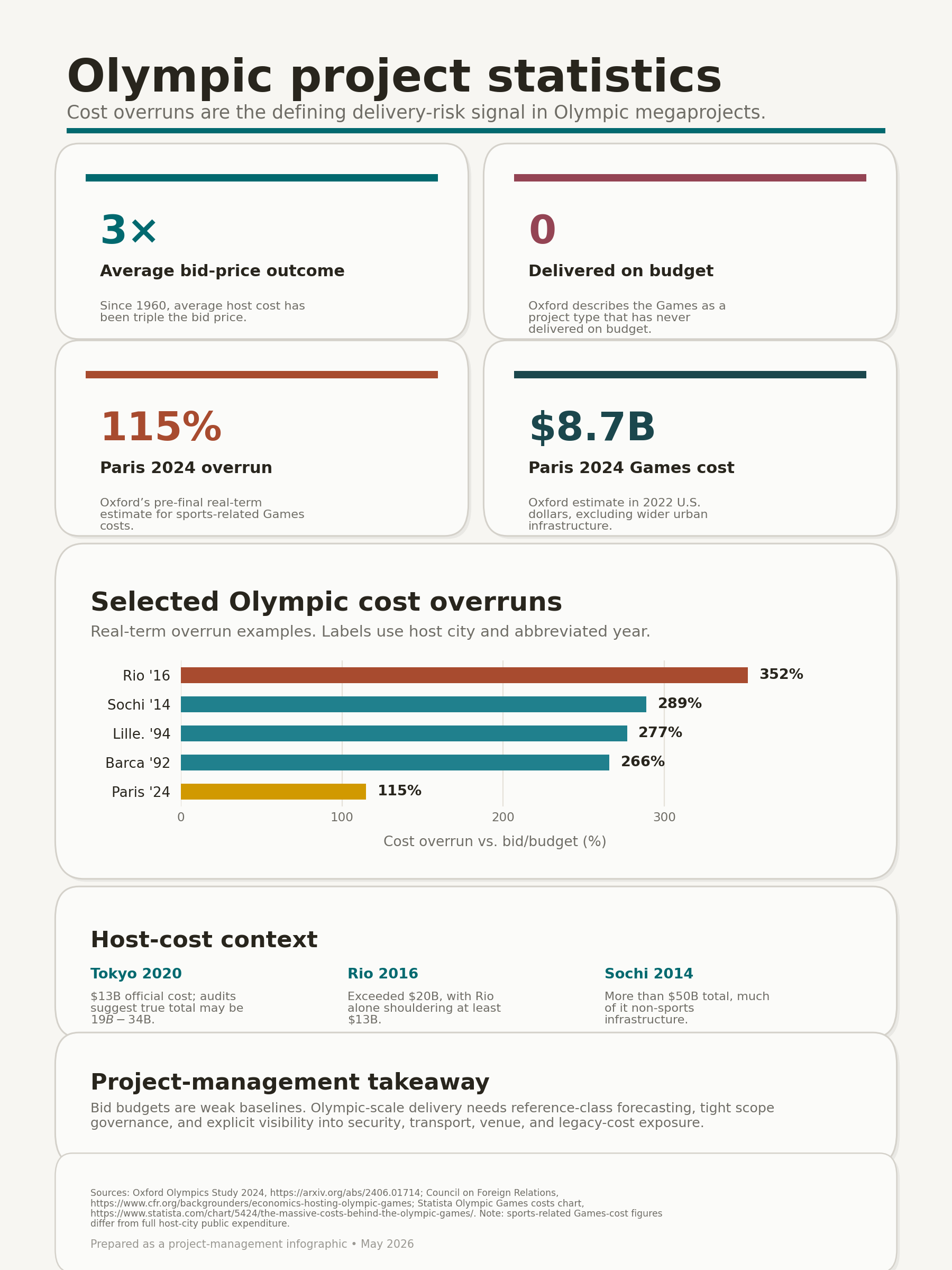
Bent Flyvbjerg has spent decades studying why megaprojects fail. His latest research, published in Public Management Review, turns to the Olympics as a natural experiment. The Games repeat on a fixed cycle, involve enormous budgets, carry extreme public scrutiny, and leave extensive data trails. If any class of projects should learn from its predecessors, it is this one.
They largely do not. And the paper’s four propositions explain why.
Proposition 1: Learning does not arise from routine operations.
Organizations tend to assume that experience accumulates automatically. It does not. Learning requires deliberate design: structured after-action reviews, accessible knowledge repositories, intentional handoff protocols. Without that infrastructure, institutional experience evaporates at the end of every project. The next team starts from near-zero.
Proposition 2: Learning is unevenly distributed inside organizations.
An organization can improve its execution mechanics, how it runs procurement, tracks milestones, manages vendors and still keep failing at the strategic level. Lower-level learning and higher-level outcomes operate in different loops. Getting better at the wrong things is still getting worse at what matters.
Proposition 3: Distance degrades transfer.
As cultural, administrative, geographic, and economic distance increases between a reference project and a new one, performance deteriorates and variability grows. What worked in Tokyo does not transfer cleanly to Paris. What worked in Paris does not transfer cleanly to Los Angeles. Context is not a footnote. It is a load-bearing variable.
Proposition 4: Time gaps kill institutional memory.
Projects with long intervals between iterations perform worse than frequent ones. The mechanisms are straightforward: records get lost, team composition changes, and tacit knowledge walks out the door with the people who held it. Frequency is a prerequisite for learning to compound. The Olympics come every four years. That is enough time for an organization to forget almost everything.
The through-line across all four propositions is the same: learning is not a byproduct of doing. It is a system. And most project organizations do not have that system. They have history. History and learning are not the same thing.
This matters beyond the Olympics. IT modernization programs, large infrastructure initiatives, enterprise platform migrations — they share the same structural conditions. Long gaps between major investments. High staff turnover. Cross-agency and cross-contextual distance. Almost no formalized knowledge transfer infrastructure. Flyvbjerg’s propositions are not abstractions for those programs. They are a diagnostic.
The question worth sitting with: in your organization, what is the actual mechanism by which one project’s hard-won knowledge reaches the next project’s team?
If the answer is “people remember” or “it’s in the documentation somewhere,” you already know what Flyvbjerg would say.
Nicole
https://www.tandfonline.com/doi/pdf/10.1080/14719037.2026.2650426
Another fabulous and eminently sharable post! Thanks for committing to such clear prose. Makes me think of when Lisa Simpson electrified a cupcake to see how many times Bart would shock himself grabbing for it....and the beat goes on...
The history/learning distinction is the part that stayed with me. Past failures are raw material, not the lesson itself. Without something that processes the material, you just have a pile of receipts. The four propositions are essentially descriptions of the missing processor.
Worth adding: a lot of what we learn doesn't have to come from our own failures. Other people's mistakes are also material, if anyone is collecting them. The internet used to be much better at this — someone's personal blog with a quiet "mistakes I made setting this up" entry was infrastructure, even if it didn't call itself that. Some of that has thinned out. The implicit assumption now seems to be that someone, somewhere, must have written it down. Which is the same failure mode as "people remember," just on a larger scale.
On Proposition 2: in my experience, the unevenness isn't only about which level learns what. It's also about what happens to the lesson as it travels upward. The pattern looks something like this: "we had a serious problem with X" → "there were some issues with X" → "X went mostly fine" → "no problems." The information is filtered for palatability at every handoff. By the time it reaches the level that allocates budget for the next iteration, the lesson has been smoothed into "we're handling it." Failures also get hidden outright in some cases. Either way, what arrives at the strategic level is a polished version that no longer contains the texture the next team would need.
A closing thought: if you fail, fix it, and the same failure keeps showing up, the fix wasn't a fix. It was a performance of one. The mistake stops being a single event and becomes a standing condition. That seems to be what the Olympic data is showing on a slow loop.