

From Reporting to Learning: The Next Evolution of Portfolio Governance
Designing a Learning Architecture for the Strategic PMO

Most project management systems are built to capture, calculate, and display information. They track milestones, budgets, risks, resources, and status updates. They aggregate those inputs into dashboards and executive packets. They improve visibility. Visibility is foundational. But visibility is not the same as learning.
Reporting answers:
What is the current variance?
Which projects are red?
How much have we spent?
What risks are open?
A learning portfolio system asks:
Given what has happened across this portfolio over time, what is likely to happen next?
Dashboards describe. Learning systems anticipate.
This article reflects my current understanding and research as I continue building depth in AI-enabled governance and portfolio systems. The workflow described here is a structural exploration rather than a final prescription. Some components may not apply in every organization. My aim is to think carefully about what it would take to transform a project management information system (PMIS) from a reporting repository into a decision architecture that improves over time.
Check out my previous introductory article on this subject.
From Reporting Infrastructure to Pattern Infrastructure
In most enterprise PMIS environments, the architecture looks like this:
Field → Calculation → Visualization.
Project managers update:
Start and end dates
Budget baselines
Actual spend
Percent complete
Milestones
Risk and issue logs
Resource assignments
Status indicators
The system calculates schedule and cost variance. It rolls up project health. It presents dashboards.
Over time, that system accumulates years of structured data. Inside that history are patterns:
Early budget drift that consistently precedes large overruns
Scope churn that correlates with milestone instability
Repeated risk escalation signals that precede executive intervention
In many portfolios, this history becomes archive material. It exists, but it is not systematically analyzed.
A learning-enabled portfolio treats that historical data as a pattern library.
Step 1: Structural Decision Design
Before building any model, define the decision layer. Intelligence must connect to governance actions.
For example:
Which intake proposals require deeper review?
Which active projects merit earlier escalation?
Which portfolio segments require capacity reinforcement?
Structural decision design requires clarity on:
Trigger thresholds
Accountable decision authorities
Escalation pathways
Documentation standards
Override mechanisms
Feedback capture
Without defined decision pathways, predictive outputs remain isolated metrics.
With structure, probability becomes governance input.
Step 2: Data Architecture and Statistical Sufficiency
Learning depends on disciplined data architecture.
Milestones must be defined consistently.
Budget baselines must follow standardized methodology.
Risk severity scoring must use common taxonomy.
Outcomes must be labeled clearly and consistently.
Predictive strength depends on portfolio scale, consistency of labeling, and stability of governance definitions.
A small or highly inconsistent dataset will limit reliability. Class imbalance can distort results. Correlation does not equal causation. A model identifies structural similarity, not certainty.
A learning PMIS requires both clean data and realistic expectations about statistical strength.
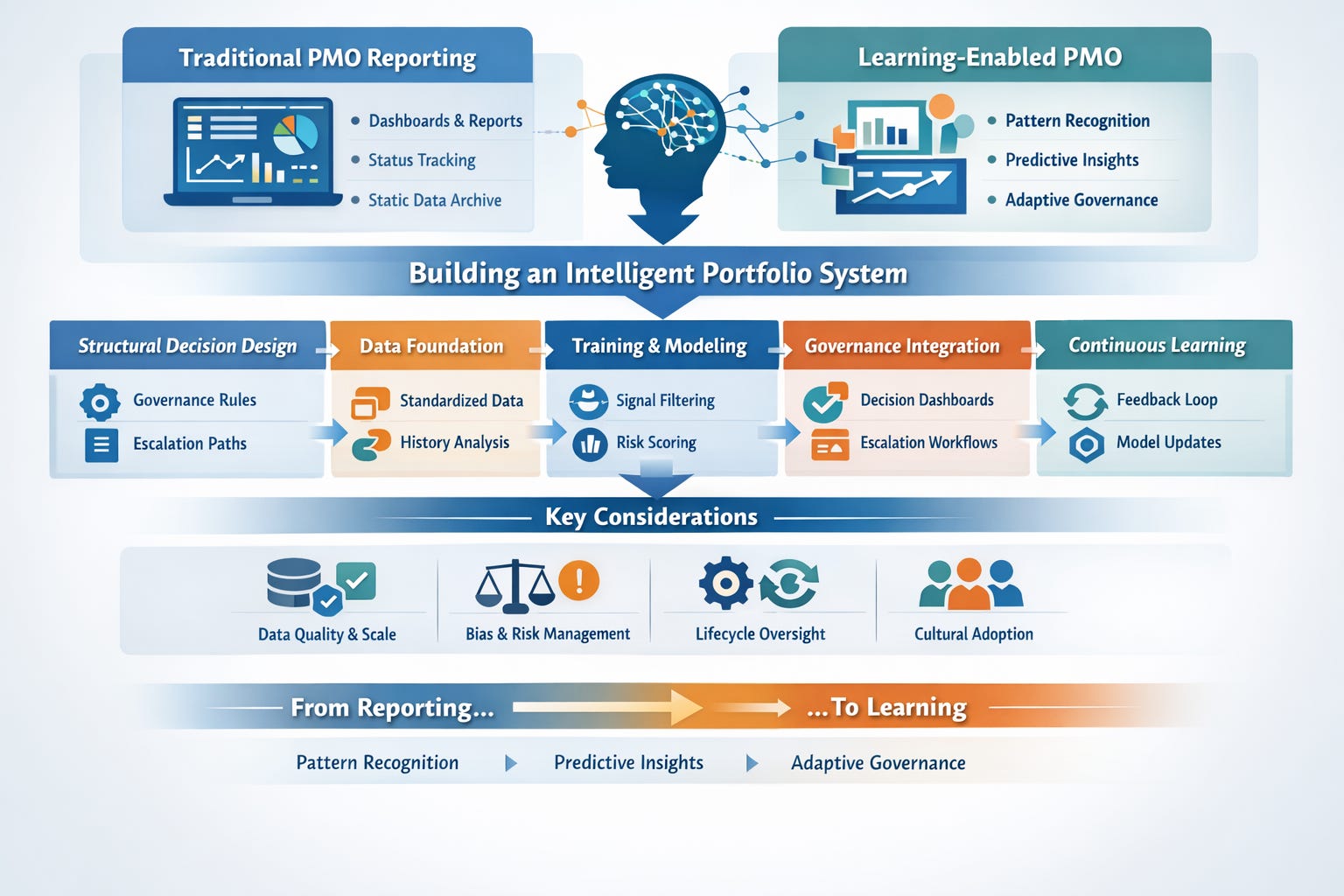
Step 3: Build the Training Dataset and Enable Portfolio Signal Filtering
Historical projects become structured training material.
Extract:
Budget trajectories
Milestone variance sequences
Risk frequency and severity trends
Scope change counts
Vendor onboarding delays
Escalation events
Final project outcomes
Label outcomes such as:
Completed on time
Exceeded budget
Escalated to executive review
Terminated early
Transitioned successfully to operations
This enables portfolio signal filtering.
Instead of treating every risk log entry as equally meaningful, the system identifies which combinations of signals historically preceded material performance degradation and which signals were routine noise.
The portfolio shifts from surface-level monitoring to pattern recognition.
Step 4: Train, Score, and Calibrate Thresholds
Models may include:
Supervised classification for escalation likelihood
Time-series forecasting for cost trajectory
Clustering for portfolio segmentation
Anomaly detection for unusual behavior patterns
The output is a probability score.
For example:
This project shows a 64 percent likelihood of exceeding its cost baseline based on historical similarity.
Threshold design becomes critical.
Thresholds may vary by portfolio segment. High-innovation initiatives may tolerate wider probability bands before escalation. Compliance-driven initiatives may require tighter thresholds.
Calibration should be iterative. Governance boards can review false positives and false negatives and adjust thresholds over time. Probability is a decision support signal, not a rigid trigger.
Step 5: Embed Into Governance Workflows
Integration matters.
In a modern architecture, predictive models may operate within a cloud-based data platform such as AWS or Google Cloud analytics services. Historical portfolio data can be stored in a centralized data lake, processed through managed machine learning services, and surfaced via business intelligence platforms such as Tableau.
Integration patterns might include:
Automatic scoring of new intake submissions upon entry
Portfolio dashboards that include probability distributions
Governance board packets that summarize emerging statistical clusters
Escalation workflows that incorporate model signals alongside human review
The model becomes one input in a structured decision ecosystem.
Agentic Reasoning in the Portfolio Context
Agentic reasoning in this environment means the system is capable of:
Sensing patterns across structured and temporal data
Interpreting those patterns against defined governance constraints
Recommending procedural next steps
Learning from actual governance outcomes
If leadership consistently overrides certain recommendations, that decision pattern can feed back into retraining cycles.
The portfolio becomes adaptive.
Lifecycle Management and Concept Drift
Predictive models require lifecycle oversight.
Portfolio composition may change. Delivery methods may evolve. Funding structures may shift. These changes can alter underlying statistical relationships, a phenomenon known as concept drift.
A learning-enabled PMIS must define:
Retraining cadence
Model version control
Performance monitoring metrics
Audit logging
Independent validation reviews
Without lifecycle management, model accuracy can degrade over time.
Governance Risk and Behavioral Implications
Predictive scoring introduces new governance considerations. False positives can create unnecessary escalation workload. False negatives can create misplaced confidence.
Teams may adjust behavior to avoid triggering model thresholds.
Probability scores must augment judgment, not replace it. Clear communication of model limitations and override authority is essential for institutional trust.
A Concrete Scenario
Consider an intake submission for a multi-year modernization effort.
The proposal is automatically scored against historical portfolio patterns.
The system detects similarity to prior projects that experienced early cost drift.
The probability of overrun is calculated at 58 percent.
Governance policy defines that projects above 55 percent probability require enhanced financial review.
The board conducts deeper sensitivity analysis before approval.
After two quarters, actual performance data feeds back into the training dataset.
The system learns not only from project outcomes but also from governance decisions.
The Strategic Shift
This transforms the identity of the PMO.
A reporting PMO coordinates status.
A learning-enabled strategic PMO becomes:
A portfolio signal filtering layer
A structured escalation architecture
A probabilistic risk interpretation engine
A decision design function
Instead of asking only, “What is the status?” leadership begins asking:
What is emerging?
Where should we intervene earlier?
Which segments are structurally fragile?
How should thresholds evolve over time?
The shift is architectural.
Reporting organizes information. Learning extracts structure from accumulated experience.
Agentic reasoning embeds adaptation into governance.
Why This Exploration Matters
I am building my expertise in this area deliberately. AI applied to governance and portfolio systems sits at the intersection of data science, compliance, behavioral economics, and organizational design.
Not every organization will adopt a predictive PMIS. Adoption requires data maturity, statistical sufficiency, and cultural readiness.
But even exploring this architecture sharpens how we think about projects.
Projects are not isolated execution efforts. They are components within a dynamic system of incentives, signals, constraints, and decisions. Designing a learning-enabled portfolio system is ultimately about strengthening that system. It is about turning accumulated experience into structured foresight.
And that is the next evolution of portfolio governance.
Nicole