


When “Systems Thinking” Talk Goes Sideways Online
I shared a short note about systems thinking: a quote from Diana Montalion’s *Learning Systems Thinking* and a line I joked should go on a t‑shirt:
“We could say that the most valuable quality of a systems thinker is they know they don’t know.”
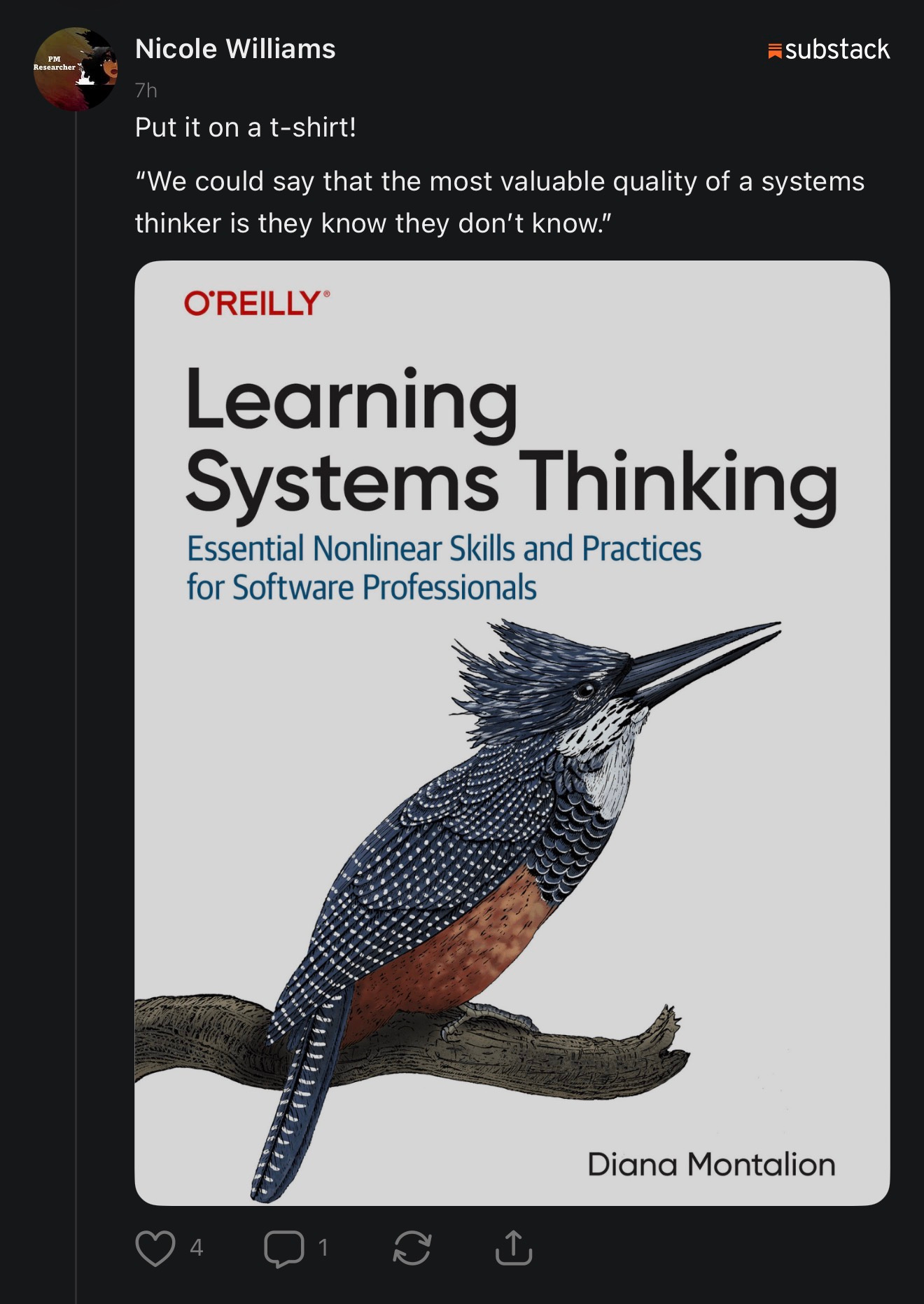
What I meant was simple: systems thinking, as I practice it, starts with epistemic humility. Complex systems will always exceed your picture of them. You assume your understanding is incomplete, you expect to be surprised, and you treat your conclusions as provisional, something to be tested against how the system actually behaves over time.
I wasn’t trying to make a metaphysical claim about knowledge. I was naming a stance.
How the conversation derailed
The reply that kicked things sideways didn’t engage that stance at all. Instead, it went after the phrase:
- “You know what you don’t know is an illogical statement.”
- “If you are a top‑down and bottom‑up thinker that statement should make you feel confused.”
- Followed by a description of systems thinking as a kind of higher‑dimensional, “3D or above” practice only “real” systems thinkers can do.
In other words, my “know I don’t know” got read as a literal logical claim, “you know what you don’t know” and then rejected as incoherent. From there, the conversation shifted into gatekeeping: who counts as a proper systems thinker, which tools they must use, and what level of abstraction they should be operating on. Remember we covered this with my article are we born with it or learned.
By that point, we weren’t having the same conversation:
- I was talking about a posture toward your own models.
- They were talking about literal semantics and identity.
The words looked the same, but the object of concern had changed.
Two meanings of “I don’t know”
Part of the clash is that the same phrase is doing different jobs:
- In my post, “I know I don’t know” is shorthand for epistemic humility. I’m acknowledging that my mental model is partial and probably wrong in important ways, and that I need to keep learning from the system itself.
- In their comments, “you can’t know what you don’t know” is a literal paradox. If the unknowns are truly unknown, you can’t list them, therefore the sentence must be nonsense.
Those are technically compatible ideas. Of course I don’t have a complete inventory of everything I’m ignorant of. That’s not what the slogan is trying to say. It’s pointing at awareness of limits, not an exhaustive map of them.
This is where Donella Meadows is useful. She keeps reminding us that in complex systems, “we can’t control systems or figure them out. But we can dance with them.” That dance assumes your understanding is incomplete and must be continually adjusted as you observe stocks, flows, feedback loops, and delays. The humility isn’t a bug; it’s the entry ticket. That’s the tradition I was drawing from.
When theory talk becomes status talk
There was another layer to the exchange that felt familiar: theory talk doing status work.
The pattern looked like this:
- Declare the phrase “illogical.”
- Invoke specialized language (top‑down, bottom‑up, 3D, binary practice).
- Conclude that if you don’t see the problem, you must not be a serious systems thinker.
It’s a very online move: use technical vocabulary to position yourself as holding the “real” version of a concept, and imply that disagreement is a sign of lesser understanding rather than a different frame.
I’m not immune to that impulse either. But it’s worth noticing that once the conversation slides into “who really gets it,” we’ve left the terrain of systems and wandered into the terrain of identity.
What I was actually trying to say
If I strip my post back to its bones, it was really about three ideas:
- Complex systems are bigger than any one model.
You will never fully capture an organization, a policy regime, or a socio‑technical platform in a neat diagram. There will always be dynamics you didn’t anticipate.
- Your models are tools, not trophies.
The point of building a mental model isn’t to be “right” once, it’s to have something you can keep testing against what the system actually does, and then revise.
- Humility is a practice, not a personality trait.
“I know I don’t know” isn’t self‑deprecation. It’s a commitment to keep listening to behavior, to data, to people at different vantage points, so that your understanding can keep changing.
In that light, the line I liked from Montalion reads less like a slogan and more like a constraint: if you can’t tolerate the feeling of “I don’t fully understand this,” you’ll be tempted to pick a story and start defending it. At that point, no amount of systems vocabulary will help you.
A practical move for sharing thinking online
The whole exchange taught me something useful about talking publicly about “how we think” in complex work.
When these conversations go sideways, a lot of the friction comes from people operating at different levels without saying so. One person is talking about stance, another about formal logic, another about identity or status.
The practical move I’m taking from this is simple:
- When you share a thinking tool or quote, name the level you’re speaking at.
That can sound like:
- “I’m talking about a stance here, not a precise logical statement.”
- “I’m using this phrase as shorthand for a kind of humility, not claiming to have an inventory of unknowns.”
- “I’m not defining who counts as a systems thinker; I’m describing one habit I’ve found valuable.”
This doesn’t guarantee harmony. Some people are invested in the semantics fight. But it does three things:
1. It keeps *you* anchored in the system you were actually trying to describe.
2. It gives others a handle on what your words are supposed to be doing.
3. It makes it easier to recognize when a thread has left the territory you care about and when it’s time to, calmly, leave it there.
And if nothing else, it’s a reminder that online discourse is its own system, with its own feedback loops and incentives. Sometimes the most systems‑literate move is not to fix the comments, but to learn from how they behave and then, calmly, let it be.
I love this! It reminds me a bit of Twain’s most famous quote: “It ain't what you don't know that gets you into trouble. It's what you know for sure that just ain't so."
Fabulous piece