

Systems Thinking Is Having a Hot Topic Moment.
Here’s What the Postings Are Actually Saying.

Last August, I argued that systems thinking has to come before analytical thinking, not alongside it. The piece did something I didn’t expect: over 3,000 likes, 123 comments, more engagement than anything else I’ve published.

Donella Meadows had a phrase for how she treated her own models: dance with the system, don’t fight it. Watch what it does, update what you believe, stay loose. That’s the spirit I want to bring back to this thesis eleven months later. So here’s the update of one piece of evidence from the ground, and one from the aggregate.
The bottom-up signal
A few days ago I posted a note with a screenshot from a current (as of this posting) Twitch job listing of a “Preferred Qualifications” section, nothing more:
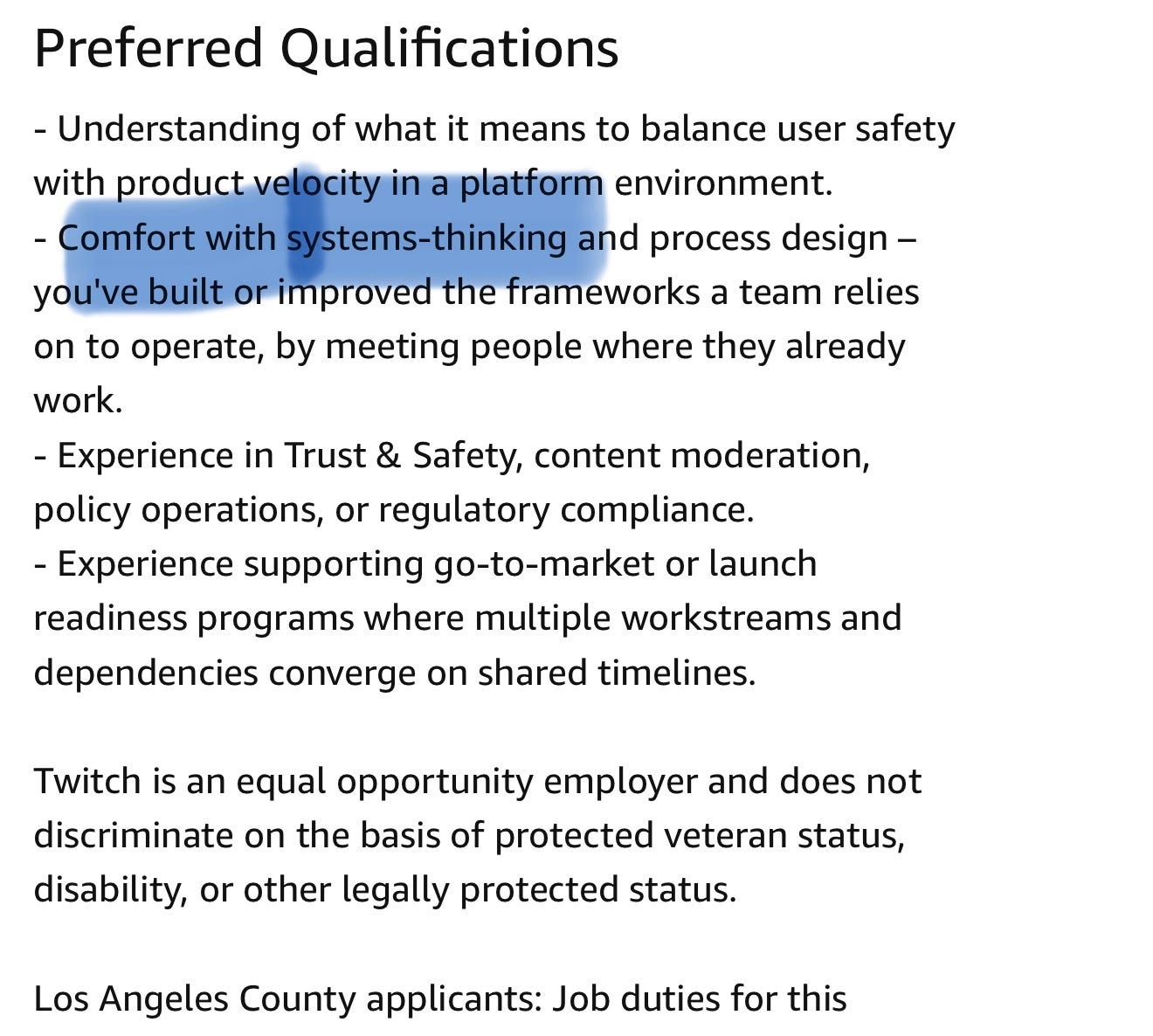
Twitch, preferred qualifications highlighted: “Comfort with systems-thinking and process design — you’ve built or improved the frameworks a team relies on to operate, by meeting people where they already work.”
It doesn’t prove a trend by itself. But I have more.
Other companies making the same move
Government and international policy work has used this vocabulary for years. Defra, the UK’s environment department, runs an entire Systems Research Programme to navigate “complex, cross-cutting and interdependent policy issues” (UK Government job listing).
“Systems thinking puts world leading evidence at the forefront of Defra’s strategy and decision making. This multidisciplinary and research-led approach to problem solving is already shaping innovative and well-informed solutions to some of the UK’s greatest environmental challenges.”(Department of Environmental, Food and Rural Affairs, UK)
The World Resources Institute is hiring a Systems Transformation Policy Lead to work the “policy design… systems thinking, and cross-sectoral coordination” angle on Indonesia’s food economy (WRI). None of that is new as complexity has always been the native language of policy work.
What’s new is who else is reaching for the same skills.
Mercury, the fintech, is hiring a Staff Visual Designer for its Design Systems team and names systems thinking as a requirement outright… “comfortable balancing expressive visual design with the pragmatic needs of a scalable design system for a data rich product” (Mercury, July 2026). This is a design job, not an engineering one. Even visual craft now has to answer to a system, not just a screen.
Nexthink, an enterprise IT platform, wants a Senior Product Manager who brings “systems thinking: strong analytical skills with the ability to structure ambiguous problems, define scalable solutions, and connect technical trade-offs to business value” (Nexthink, December 2025), explicitly to help the platform absorb “AI-first use cases” without the foundations cracking under the added weight.
enGen, the healthcare technology arm behind Highmark’s dental plans, requires “strong systems thinking” for a Business Systems Analyst who has to trace a single issue across data, configuration, and system behavior at once (Highmark Health, via Built In). Healthcare’s complexity was never in question. What’s notable is a mid-level analyst role naming the skill outright instead of assuming it.
Then there’s System, a healthcare-focused public benefit corporation that built the vocabulary into its identity. Its own description reads: “System builds software to help the world see and solve anything as a system.” The general application for its operations and strategy track doesn’t list systems thinking as a nice-to-have. It opens with “Welcome systems thinkers” (System, June 2026).
Two more names belong on this list, and they’re the two biggest.
Amazon doesn’t just require the skill, one posting actually says what it’s for. A Scaled Abuse Specialist role on Amazon’s Trust and Store Integrity team exists, in the company’s own words, to “protect Amazon customers and stores by applying systems thinking to understand how networks of users interact with multiple services” (Amazon Careers). That’s the clearest statement in this entire list of why the skill matters, not just that it does: fraud doesn’t happen inside one service, it happens in the seams between services, and somebody has to be able to see the seams to catch it. The same logic shows up again in Amazon’s sustainability hiring, where a Senior Sustainability Specialist must “apply systems thinking to complex, fast moving problems while dealing with uncertainty and data gaps” (Amazon Careers), a different domain, the same admission that no single team can see the whole picture alone.
Microsoft is asking for the same aimed at product decisions instead of fraud patterns. A Senior Product Manager role on Microsoft Teams asks candidates to “champion a systems-thinking approach to product development, considering the downstream implications of core design decisions on the broader Teams ecosystem” (Microsoft Teams PM listing), because one change to the core messaging engine ripples across chats, channels, and meetings for hundreds of millions of people at once. A separate Microsoft posting, for a PM shaping the Facilitator agent inside Teams meetings, frames it even more plainly: the job is for someone who enjoys “ambiguity, systems thinking, and building AI experiences that must work reliably in the real world.”
Six companies, six very different roles: a design team, a product platform, a healthcare back office, a company’s entire reason for existing, a fraud investigations unit, and the team deciding how an AI agent behaves in a meeting. The line connecting all of them is the one from the Twitch posting. None of these roles are being asked to optimize one part, one component, one area. The ask is to answer for what happens when the parts start talking to each other, and in Amazon’s case, to say so directly instead of leaving it implied.
The cost of skipping it
None of this is only about which skill gets listed in a posting. There’s a harder case underneath it, and it comes from a peer-reviewed paper, not a job board: companies that skipped systems thinking didn’t just miss a trend. They lost the market. I wrote about this in several articles.
Researchers at Worcester Polytechnic Institute catalogued a set of well-known business failures that trace back to exactly this gap (Monat, Amissah & Gannon, Systems, 2020). The pattern repeats often enough to stop looking like coincidence.
Microsoft built the Zune to compete with the iPod in 2006. The hardware wasn’t the failure. Apple had built the licensing deals, the payment infrastructure, and iTunes built the entire apparatus that made owning an iPod worth it. Don Norman put it plainly: “It is not about the iPod; it is about the system… No one seems to understand the systems thinking that has made Apple so successful,” as the paper quotes him. Microsoft matched the device. It never built the system the device was supposed to live inside.
Polaroid led the digital camera market by 1990 ahead of Sony, ahead of Kodak, then filed for bankruptcy by 2001. Leadership kept funding digital R&D through a hard-copy-print mental model, protecting a film business with 65% margins instead of following where the technology, and the customer, were actually headed.
The Long-Term Consequences of Quick Wins

In my last article, I explored the value of taking a concept from one domain and applying it in another. This practice stretches our thinking and helps us see patterns across systems. Some of the mos…
BlackBerry held over 10 million subscribers and a $67 billion valuation in 2007. It kept building a secure email device while Apple and Samsung built a mobile entertainment system that happened to also send email. By 2013, BlackBerry posted a $1 billion loss on unsold inventory nobody wanted.
The oldest example in the paper predates all of them. Swiss watchmakers controlled 65% of the world’s watch sales through the 1960s, on the strength of mainspring-driven movements they’d refined for generations. In 1968, their own researchers invented the quartz movement, battery-powered watch with no mainspring at all. The industry looked at its own invention and decided traditional watchmaking would simply outlast it. They didn’t even patent the idea. Seiko did. By 1978, the number of Swiss watchmakers had dropped from 60,000 employees to 10,000, and Swiss market share had fallen below 10%.
None of these companies were short on talent or capital. Each optimized a part while missing what the part sat inside of, the same distinction this newsletter keeps circling back to. Read against that history, the postings above stop looking like a buzzword rotation. They look like companies writing down, in a job requirement, a lesson several of their competitors already paid for in market share.
The top-down signal
Zoom out further, and the aggregate data is triangulating on the same point from a completely different altitude.
• Dice’s mid-2026 tech jobs report lists Systems Thinking among the skills with 250%+ year-over-year growth in postings in the same bracket as Agentic AI, AI Agents, and AI Infrastructure. It isn’t rising alone. It’s rising with the agentic AI buildout (Dice, 2026 Tech Jobs Report).
• LinkedIn’s Skills on the Rise 2026 list singles out systems thinking specifically for program and project management roles, describing it as the ability to “see upstream and downstream dependencies and build holistic solutions, especially when legacy systems lurk” (LinkedIn News).
• The World Economic Forum’s Future of Jobs Report 2025 named the structural drivers directly: the expansion of AI and big data, and the growth of autonomous systems that require someone managing the interface between human judgment and machine action (World Economic Forum).
• Coursera’s learning data shows hours spent on systems thinking courses climbing since 2022, with a sharper jump starting in 2024 — professionals were feeling for the leverage point before most job descriptions had language for it (Coursera / WEF, New Economy Skills report).
• McKinsey’s late-2025 research found demand for AI fluency grew nearly sevenfold in two years, with demand for complementary skills like process optimization and quality assurance rising right alongside it — because once AI is doing pieces of a workflow, someone still has to hold the whole loop together (McKinsey).
Top-down and bottom-up rarely agree this cleanly. When they do, it’s worth taking seriously.
What this actually means
Meadows spent a career arguing that the leverage isn’t in the parts, it’s in the structure connecting them: feedback, incentives, the rules nobody wrote down but everyone follows. Read the postings with that lens and “systems thinking” as a qualification decodes into something specific. It rarely means the candidate has read a systems theory textbook. It means the employer wants someone who can:
• Trace second- and third-order effects across teams or tools, not just execute inside their own lane
• Improve the operating structure a team runs on, rather than just work within it
• Manage the handoff between human judgment and automated or AI-driven steps, now that “the system” includes non-human actors
• Translate between departments or domains that don’t naturally share a vocabulary
That’s the difference between a local move and a system stance, applied to a career instead of an org chart. Analytical thinking optimizes your lane.
This is the qualification for people who are expected to notice the lane itself is the constraint.
Look closely at how these postings actually phrase the requirement, and something else shows up: none of them ask for systems thinking in place of analytical rigor. Amazon’s Sustainability Specialist role requires “strong analytical skills and the ability to apply systems thinking to complex, fast moving problems” not one or the other, both, in the same sentence (Amazon Careers). Nexthink’s listing pairs them the same way, naming “systems thinking: strong analytical skills” as a single qualification rather than two competing ones (Nexthink). LinkedIn frames it as what analytical thinking misses on its own: the thing you need “especially when legacy systems lurk” (LinkedIn News).
That’s closer to the original argument than a replacement would be. These companies aren’t demoting analytical thinking. They’re writing down, in the same line, that it isn’t sufficient by itself — which is the claim from last August, restated by people who have never read the piece.
Where the model stands now
I don’t think the data settles the argument outright. WEF’s own ranking still puts analytical thinking above systems thinking as the top core skill employers name (World Economic Forum). So the strict claim, systems thinking before analytical thinking, is still the harder position to hold, not the consensus one.
What’s changed since August is the direction of travel. The growth curves, the plain-language postings, a streaming platform quietly asking content moderators for the same fluency a systems engineer would need, Amazon naming the exact fraud mechanics the skill is meant to catch, a documented trail of companies that paid for skipping it: none of that existed as evidence eleven months ago. I’m not calling the argument proven. I’m updating the model with what the system just told me, which is the only honest way to hold a thesis like this one.
Your turn
I’m building a running file of postings where the language is doing more work than the job title suggests. If you’ve seen “systems thinking,” “systems-level,” or “holistic frameworks” show up somewhere unexpected, put it in the comments.
Nicole
Systems thinking is the bell bottom pants of mindsets.
I think of it as cyclical weather pattern of the managerial, consultive, and academic worlds - El Systemo.
I remember 30 years ago, when my boss geeked out on the "new" idea and sent me scrambling as his systems-walla to fetch nuggets of insight to feed him like a hungry squirrel.
I dug up antecedents to earlier eras of these bursts of enthusiasm, charts, diagrams, math, formulas, and whatnot.
It creates a nice breeze, but does it ever stick?
The job posting examples are useful because they show systems language moving from conference slides into hiring requirements. My skepticism starts one step later: most interviews still reward clean decomposition, not second order effects across teams. Until candidates are asked what breaks downstream when a core decision changes, systems thinking stays in the posting more than in the building.