

Two Change Models. Two Different Purposes.
Using change models with purpose.

Change is one of the most powerful forces inside any organization, yet it is also one of the least understood. Leaders often sense the need to move, evolve, or transform, but the path forward is rarely simple. Some changes reshape systems. Others reshape people. The real challenge is knowing how to guide both at the same time.
There are two models that reveal this dynamic with unusual clarity. Each shows a different side of transformation. Each answers a different question. And when you understand how they work together, you see change in a completely new light.
If you want to lead transformation with confidence instead of guesswork, start here.

Most organizations talk about change, but change itself is rarely straightforward. Every transformation has two engines. One engine moves the system. One engine moves the people. When both engines work together, change becomes possible. When only one is activated, progress slows or stops.
Two well known models show this tension with clarity.
• PMI’s Strategy to Execution Model
• Kotter’s 8 Step Change Model
Together, they reveal the simplest truth about transformation.
Change only succeeds when the system and the people move together.
Once you see this, the entire change landscape shifts.
Let’s explore what each model offers and why understanding both gives change agents an unmistakable advantage.
The Structural Engine: PMI’s Strategy to Execution Model
PMI begins with the forces outside your organization. Markets shift. Technology advances. Regulations evolve. Expectations rise. Pressure builds long before anyone calls a meeting.
From there, PMI guides the organization through a clear sequence:
• Formulate change
• Plan change
• Implement change
• Manage transition
• Sustain change
This model answers a structural question.
What must change operationally and strategically for the future state to work.
It brings clarity to complex change by helping you:
• Define the real problem
• Map the work
• Align goals and actions
• Coordinate teams
• Stabilize the transition
• Track the value delivered
Think of PMI’s model as the structural blueprint. Without it, change loses shape.
Want to know more about problem formulation? See this article —>
The Human Engine: Kotter’s 8 Step Model
Kotter begins with energy. Not pressure, but purpose. He understands that a new system cannot survive inside an old mindset.
Kotter focuses on how people move through change:
• Urgency
• Vision
• Communication
• Coalition
• Early wins
• Acceleration
• Culture
This model answers a psychological question.
How do we motivate people to choose and sustain the new future?
It helps change agents:
• Build trust
• Lower resistance
• Strengthen alignment
• Create early momentum
• Reinforce new behaviors
If PMI is the structure, Kotter is the lift.
Without it, change stays theoretical.
Tying Everything Together
The system can shift, but if people do not move with it, the change collapses. People can be inspired, but if the system does not change, the momentum fades. Real transformation happens at the intersection of both forces. This is the truth strong change agents work from.
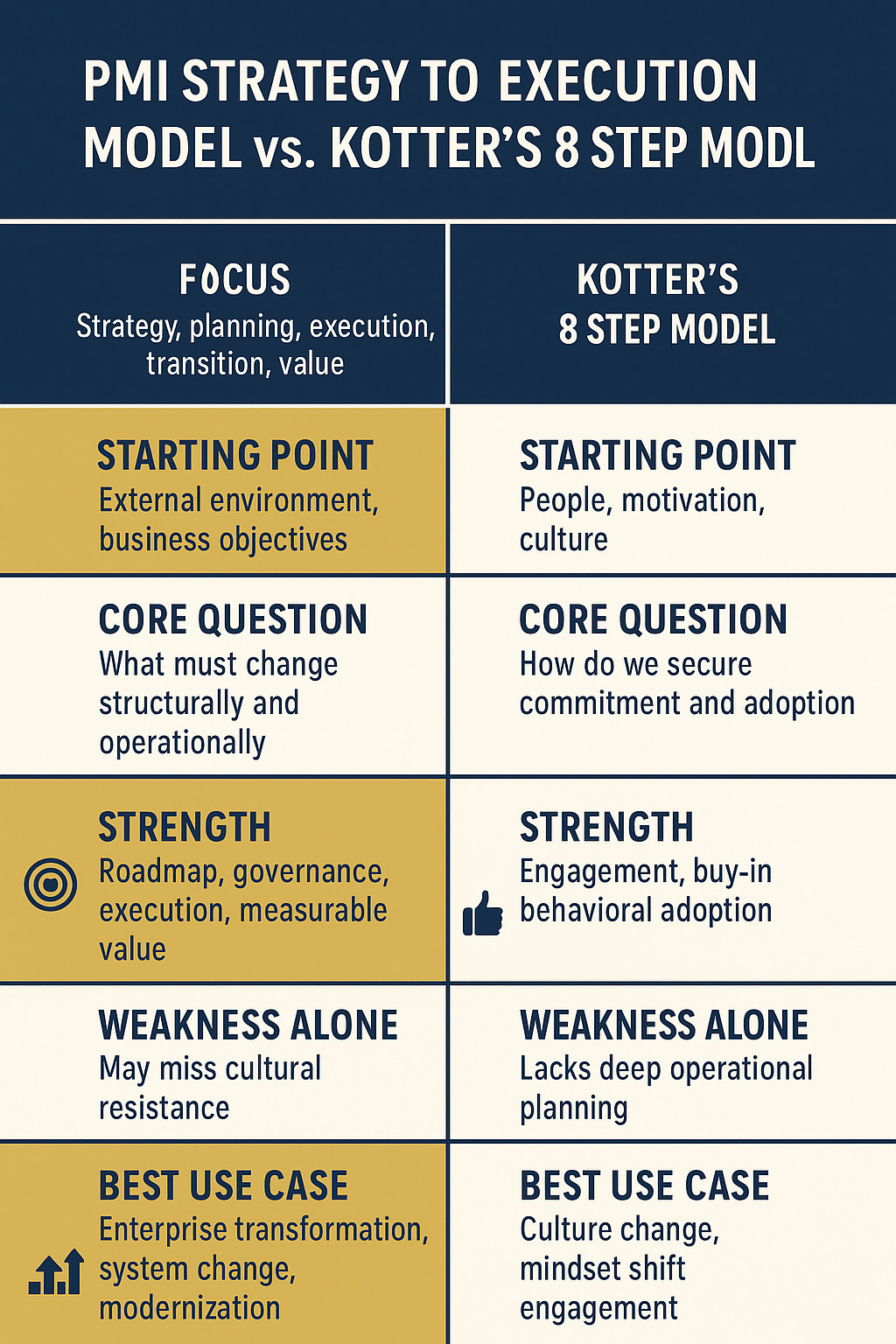
How the Two Models Work Together
If PMI gives direction, Kotter gives energy. When both work together, you create a full environment for transformation.
You get:
• A strategy people can understand
• A plan people can follow
• A message people believe
• A culture that supports the vision
• A transition that holds
• A future state that endures
Using only one model is like trying to navigate with half a map.
Why Change Agents Must Master Both
Change agents stand at the center of transformation. They connect strategy and culture. They translate vision into movement. They guide people through uncertainty and systems through transition.
To do this well, they need both models.
1. They operate inside PMI’s structure
They frame the work.
They build clarity.
They coordinate movement.
They protect the future state.
2. They influence Kotter’s momentum
Their clarity builds confidence.
Their presence builds trust.
Their communication builds buy in.
Their consistency builds culture.
3. They know which model to activate
If the system is unclear, use PMI.
If the people are resistant, use Kotter.
If the change is complex, use both.
4. They are measured by outcomes
Not tasks. Not activity. Value.
To deliver value, change agents must understand both the mechanics and the psychology of transformation.
When To Use Each Model
Use PMI when:
• The work changes systems or processes
• Structural clarity is needed
• Sequencing matters
• Governance matters
• The future state requires measurable outcomes
Use Kotter when:
• People resist
• Trust is low
• Culture must shift
• Communication is weak
• Adoption is fragile
Use both when:
• The change is enterprise level
• The change touches identity and behavior
• The change shifts how work gets done
• The change must endure
If the transformation is important, both models are required.
The Insight That Changes Everything
Transformation is not a document. It is not a timeline.
It is a relationship between structure and behavior. Between design and belief. Between the future you build and the people who must walk into it.
Once you understand this dual engine of transformation, you see change with a new kind of clarity. And you lead with a new kind of confidence.
Call to Action
If this changed how you think about change, share it with someone who is leading something important. Most transformations struggle because the people guiding them have never been taught how change actually works.
You now have the language, the clarity, and the structure to see it differently. Use it. Question it. Apply it to your next initiative. Watch what shifts when you lead with both engines and invite others to do the same.
If you want more thinking tools, strategic breakdowns, and clear insight for complex work, subscribe and stay close. This is where change agents sharpen their edge.
Hope this helps.
Nicole
Just read this and it reinforces why i have always aligned with kotter - the human change model.
Thanks for writing. It's important to balance objective-driven change and human-centered change as well. I find myself more in the Kotter world, even today while talking about implementing strategy and objectives for a business unit.