

What Codifying Project Management Would Actually Look Like
Professionalizing Project Management

Calls to professionalize project management often remain abstract. More standards. Better training. Stronger governance.
But if project management were to become a codified profession in the way engineering and accounting are codified, what would that actually mean?
Codification is not about prestige. It is about binding authority to accountability when public risk is high.
A serious model would require structural change.
Start with the engineering analogy
Project management is structurally closer to engineering than to most other fields.
Engineers design systems that must perform under uncertainty. Their decisions shape public safety and economic outcomes. For that reason, engineering is tiered:
Not every engineer needs licensure. But engineers who sign off on high-risk public work do. This is the most realistic model for project management.
Codification would not apply to every project. It would apply to projects where failure imposes public cost at scale.
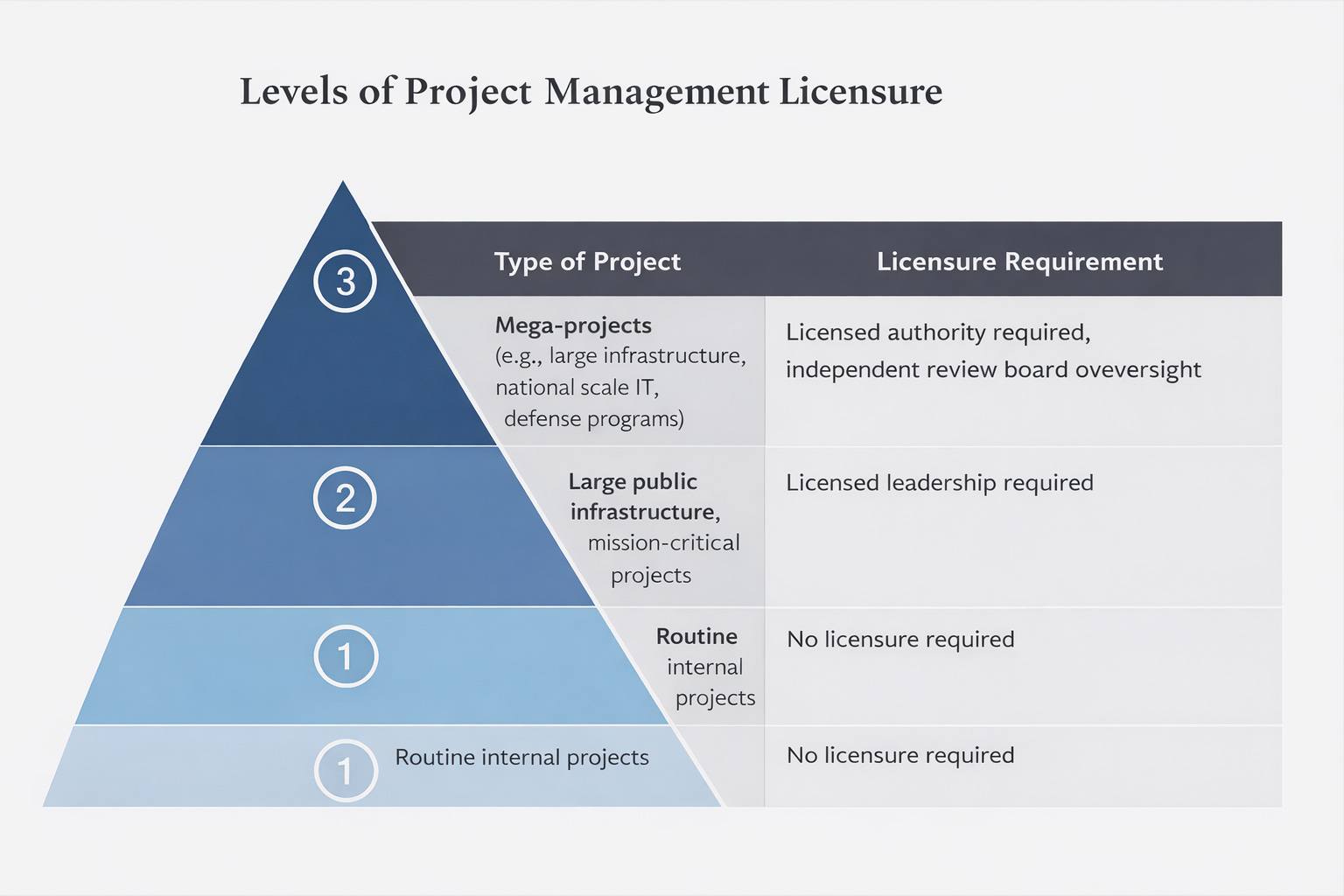
A tiered licensing structure
A codified system would likely distinguish between levels of project authority.
For example:
Routine internal projects: no licensure
Large public infrastructure or mission-critical IT: licensed leadership required
Mega-projects above a threshold: independent review and certified authority
This mirrors engineering’s logic: risk determines regulation.
Mandatory competencies beyond scheduling
Codification would require a deeper professional core.
High-risk project leadership would likely demand demonstrated expertise in:
probabilistic forecasting
reference class prediction
systems risk and complexity
governance and ethics
procurement and institutional accountability
cost realism and benefit integrity
In other words, project management would move from tools to epistemology.
Independent oversight bodies
Professions require jurisdiction. Engineering boards and accounting regulators exist because self-certification is insufficient when the public bears the downside.
Project management codification would require independent oversight with authority to:
review failures
investigate misrepresentation
sanction unethical practice
remove individuals from high-risk practice
Without this, standards remain advisory.
Enforceable duty of care
Codification would formalize something that is currently diffuse: duty.
A licensed project leader would be expected to meet a duty of care regarding:
cost and schedule realism
risk disclosure
governance integrity
avoidance of strategic misrepresentation
The goal is not perfection. The goal is professional responsibility under uncertainty.
Consequences for repeated systemic failure
Professions are defined not by failure avoidance, but by failure accountability.
In engineering, repeated negligence ends careers. In accounting, repeated misrepresentation triggers sanctions.
In project management today, repeated large-scale failure is often absorbed institutionally, not professionally.
Codification would change that.
Why this is not radical
Project management already operates inside systems of enormous consequence.
What is radical is the current mismatch:
high authority
high public cost
low enforceable accountability
Codification is simply the institutional alignment that other professions adopted once their work became too consequential to remain informal.
The real question
The question is not whether project management should become a profession in name.
It is whether society will continue to accept a domain of expertise that governs billions in public investment without the structures that other high-stakes professions require. Every mature profession faced this transition eventually.
Project management is late to it.
Next week: Why government may lead this shift before the private sector does.
Let me know your thoughts.
Nicole