


If you have been reading my recent pieces on systems thinking, you may have noticed something. I spend a lot of time asking people to slow down before acting.
That is not caution for caution’s sake. It comes from understanding where systems thinking actually comes from.
Systems thinking did not start as a leadership trend or a productivity tool. It grew out of systems theory, a body of work that tried to answer a very practical question.
Why do smart, capable people keep making decisions that seem reasonable, yet produce disappointing results?
What systems theory actually explains
Systems theory starts with a simple but uncomfortable truth. When parts are connected, they behave differently together than they do alone. Organizations are not just people. Projects are not just tasks. Policies are not just rules.
They are systems. And systems respond to pressure, incentives, delays, and constraints in patterned ways.
This explains experiences many of us recognize immediately. You fix one problem and another appears somewhere else. You introduce a better process and performance drops. You add more oversight and accountability quietly erodes. You set a target and behavior shifts to satisfy the metric rather than the purpose.
These outcomes are not mistakes. Systems theory shows that behavior is shaped by structure. That insight is the foundation of systems thinking.

How systems theory becomes systems thinking
Systems theory explains how systems behave. Systems thinking is what happens when you use that understanding while making real decisions.
Systems theory tells us feedback loops exist, while systems thinking is noticing what is reinforcing or stabilizing behavior before stepping in.
Systems theory explains that cause and effect are often separated by time. Systems thinking is resisting the urge for immediate results.
Systems theory explains that systems resist change to protect equilibrium and systems thinking is expecting pushback and planning for it rather than being surprised by it.
In other words, systems theory changes what you expect. Systems thinking changes how you act.
The moment I decided to write this article
I watched an Instagram video recently that stayed with me.
Brené Brown shared a story about a group of tech CEOs and founders who were asked what young people should study to succeed today. The answers were predictable. Learn tech skills. Learn to code. Learn physics. Learn AI.
Then someone asked a better question.
What do you study? What do you read?
The answers were not what you’d expect. The classics. Philosophy. History.
At first, this angered me. Then I realized how we can best use this information. Not as a contradiction, but as a strategic advantage.
What those leaders were describing, without naming it, is the difference between operating inside a system and understanding the system itself.

Technical skills teach you how to function within existing structures. They help you build, execute, and optimize. But philosophy, history, and literature train something else entirely. They train how judgment is formed.
What is actually being developed
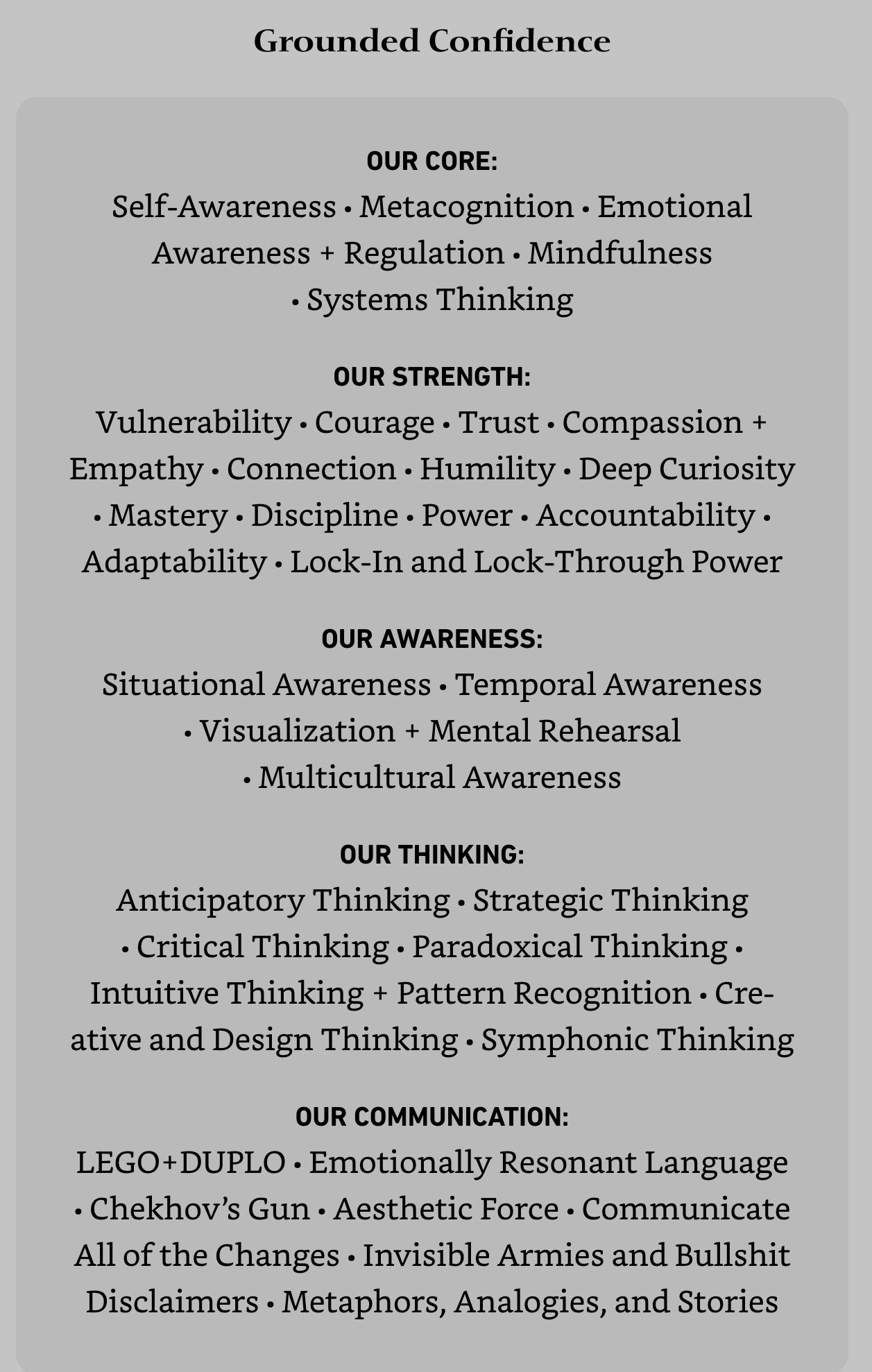
Brene Brown, during this interview gave us a foundational core skillset to complement our technical skills. I call them thinking skills.
At the core are internal capacities. Self awareness, metacognition, emotional regulation, mindfulness, and systems thinking. This internal architecture allows someone to notice their assumptions, slow their reactions, and see situations as wholes rather than fragments. Without this core, intelligence stays narrow. A person can be brilliant and still misread reality.
Around that core is strength. Vulnerability, courage, trust, humility, discipline, and accountability. This is not niceness. This is resilience with spine. The ability to stay open without being naive, to hold authority without becoming brittle, to persist without ego collapse. This is why seasoned leaders often appear calm rather than flashy. They have internal load bearing strength.
As that strength develops, awareness expands. Situational, temporal, and multicultural awareness allow someone to read a room, a moment, and a longer arc at the same time. This is what history trains. This is what philosophy sharpens. You stop asking only what is happening and start asking what phase this belongs to.
From there, thinking becomes multidimensional. Anticipatory, strategic, paradox aware, pattern based thinking emerges. This is exactly what the classics develop. When you study long arcs of human behavior, you stop expecting clean answers. You get comfortable holding tension. You recognize repeats. You learn that opposing ideas can both be true.
Finally, it all shows up in communication. Clear structure, emotional resonance, metaphor, and narrative discipline. This is why leaders read literature. Not to sound smart, but to make meaning transferable. To move people without coercion. To communicate change without panic.
(Brene Brown: Strong Ground)
Entry versus command
So when tech leaders say young people should learn technical skills, they are talking about entry (I think…hope so). Those skills get you inside the system.
When they talk about what they read, they are talking about command. The ability to shape, influence, and redirect the system itself.
Brené Brown is describing the same distinction in a different language. Tools let you participate in a system. These deeper capacities let you shape it.
My takeaway
Systems thinking works because it rests on something deeper than tools or diagrams. It rests on an understanding of how systems behave and how judgment is formed.
If you want better outcomes, do not just ask what decision to make. Ask what kind of thinker this situation requires you to be.
Hope this helps.
Nicole
Nicole, there's much to appreciate here—particularly the distinction between entry and command, between operating within a system and understanding how systems behave. That's genuinely useful.
A small historical note: systems thinking as practice was substantially developed by Peter Checkland through his Soft Systems Methodology in the 1970s and 80s, building on Geoffrey Vickers' work on appreciative systems. Project management has been wrestling with these ideas for decades. Checkland made the crucial move from "hard" systems engineering to something that acknowledged human systems require participation, not detached analysis.
But I want to raise something deeper, prompted by your rubric: "I like mental models and complex projects."
Your main argument—there are many models, choose the appropriate one for the situation—is sound advice. But it operates entirely within map-land. Even the most carefully selected model remains a map. And maps have a way of being surreptitiously substituted for reality unless we remain hyper-vigilant.
Here's what I mean. In my early forties, my squash game and skiing both improved dramatically when I encountered Tim Gallwey's Inner Game books. His techniques aren't meditation or philosophy—they're practical tricks that keep attention anchored in embodied participation. Watch how the ball is spinning at the moment it contacts the racket. Feel which part of your foot takes the greatest strain in a turn. The analytical mind can't capture reality when attention is fully engaged with something actually happening rather than a representation of what might happen.
This suggests a question your piece points toward but doesn't quite ask: what would it mean for systems thinking itself to remain embodied—to stay in participatory relationship with the messy, entangled reality it models, rather than becoming another elegant map we mistake for the territory?
What this surfaces is that systems thinking is a different compression regime for judgment. Slowing down changes which patterns get noticed before action locks them in. Without that pause, people end up optimizing locally while misreading the system globally.