


A month ago, I wrote that systems thinking is having a hot-topic moment in the job market. I also posted a note quoting the Chief Product and Technology Officer at Netflix, who said that “systems thinking is now the single most important trait she screens for”.
This got me thinking about the language in job postings and how we can interpret them. Hiring managers write postings around observable behavior and not frameworks.
So how does an applicant know what to look for when no one screens for a model they've never heard of?
They screen for what the model produces: judgment calls, risk anticipation, and handling ambiguity.
Lately, since my focus has been learning systems thinking and Cynefin, I’ll focus on these two.
Here are phrasings from current job postings that connect directly to systems thinking and Cynefin.
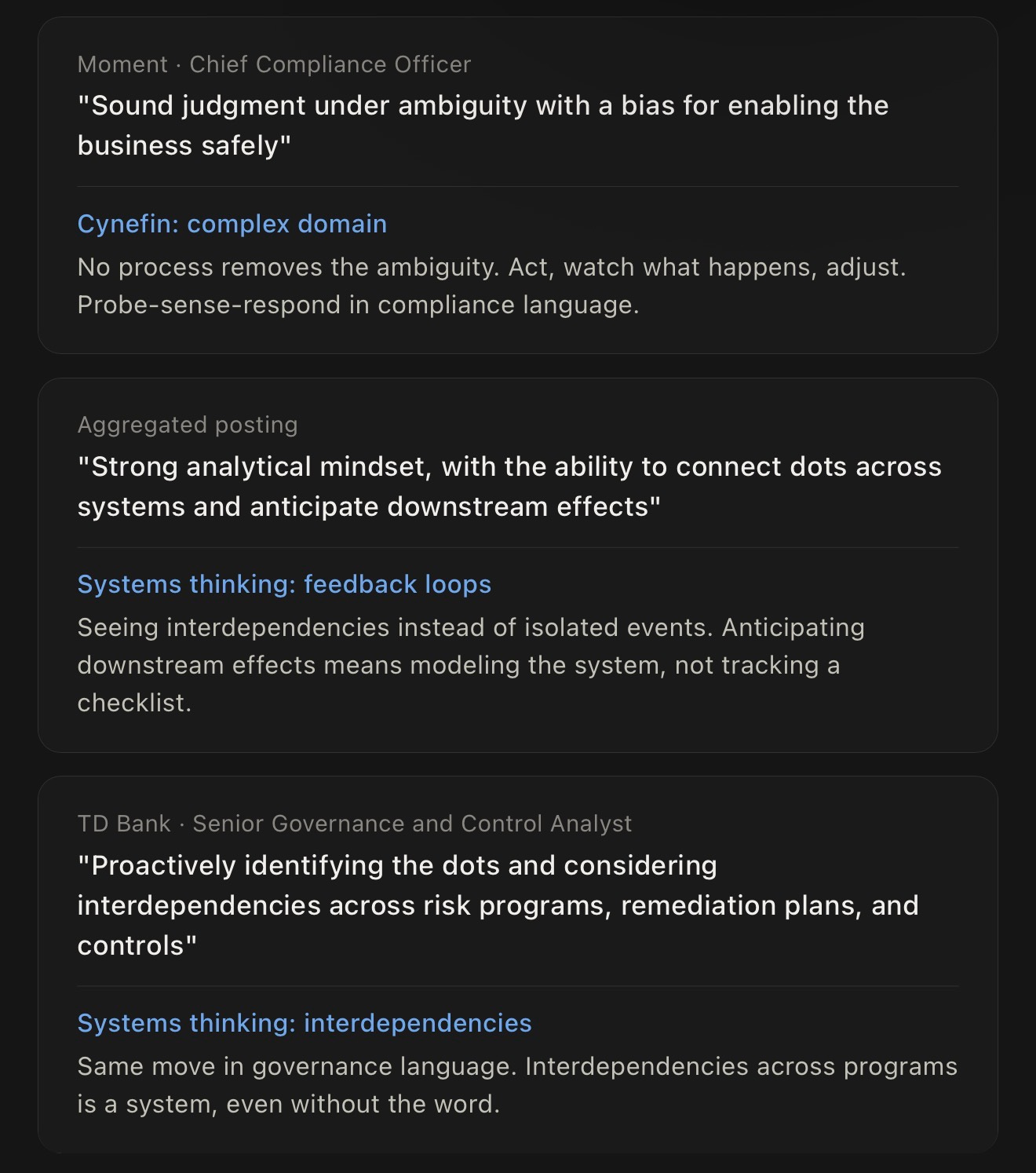
Frameworks are internal models for making better decisions. Resumes and postings are external interfaces for getting hired. If you only speak in framework language, you're filtering yourself out of roles that actually want exactly what you have.
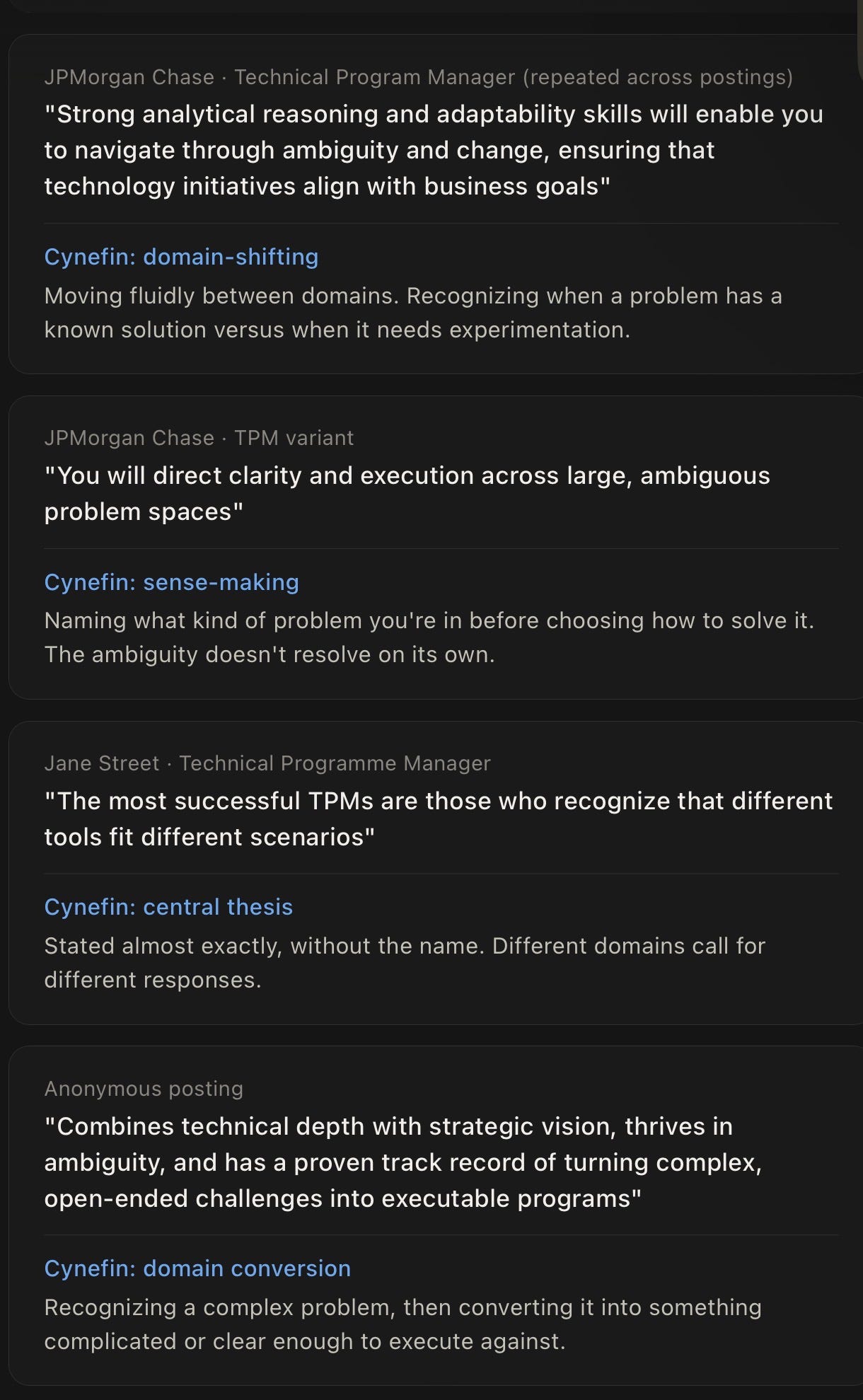
The pattern across all these postings is that none of them name the framework. They describe what the framework produces. The employer wants the output of systems thinking, without knowing or caring what the internal model is called. How do you connect the dots across systems, anticipate downstream effects, and interdependencies? How do you tackle open-ended challenges and experimentation? That is Cynefin. Your resume should speak in outcomes, not framework names.
I don't think systems thinkers can tell you that they are systems thinkers. They just approach problems differently from the rest of us, and it's obvious when you see them act or talk.
One observation of the traditional African village is that systems thinking was the default framework. It sought to optimize the whole, often at the expense of the individual part. However, the villager wouldn't describe themselves as a "systems thinker."
While they deliberately planned for nonlinearity and baked it into social norms, they would not describe their actions in Donella Meadows' or Dave Snowden's vocabularies and maxims. Rather, they would tell you about the gods and ancestors, honor and posterity. Systems thinking archetypes, framed as proverbs.
I am curious to see how recruiters will codify what it means for a candidate to be a systems thinker. The question for recuriters is whether can they recognize a systems thinker who says proverbs, rather than describe frameworks.
Lots of confused writing JDs for sustems thinking a subject the know very little about.
The knowhows required for ssm, vs, csh, soda, se, sd, sast, chat, csh are very different. Plus ST requires tge behavioural competences discussed by Morgan G, (McGill Montreal )competences for 21st c organisations.
Perhaps the writer woukd like to comment.