


Marcus Samuelsson use to work at Aquavit in NYC, infusing Scandinavian, Ethiopian, and Indian cuisine. Born in Ethiopia, raised in Sweden, trained in classical French kitchens, he lost the instinct most chefs have to stay inside one culinary tradition and defend its borders. He didn’t experience Swedish food and Indian spice and Ethiopian technique as separate countries requiring a passport to cross. He experienced them as one continuous pantry.
That’s a strange kind of freedom, and it isn’t the same as talent. What he had was something closer to a missing wall, what Frans Johansson, in The Medici Effect, calls a low associative barrier. Most people’s minds sort ideas into bins labeled by discipline or culture, and moving between bins takes a conscious, effortful shove. Some people’s minds don’t build the bins in the first place. The ideas just sit together, undivided, waiting to be combined.

(The local palate)
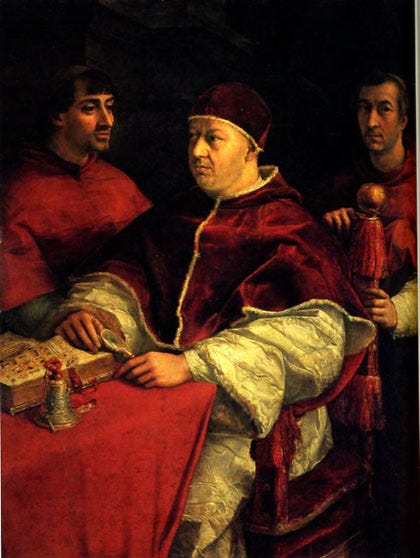
Johansson’s book is built around a claim that has become almost a cliché in innovation circles: breakthroughs happen at the intersection of fields, not within them. He names it after the Medici family, who spent the fifteenth century bankrolling painters, sculptors, philosophers, and engineers and putting them in proximity to one another in Florence. Out of that proximity came Brunelleschi’s dome, Botticelli’s mythologies, the rediscovery of classical philosophy, a concentration of genius so dense that historians still argue about how it happened at all. Johansson’s answer is that the Medicis didn’t do anything mystical. They just funded a room. Different disciplines showed up to the same dinners, the same workshops, the same patronage networks, and their proximity did the rest.
(Italian renaissance art)
It’s a good story and a useful frame. The intersection Johansson describes is geographic. It’s a place. You go to Florence, or a conference, or a company where the design team sits next to engineering, and the collisions happen because the walls came down. But if you look at the individual moments of insight inside that story, not the environment that made them possible, but the instant the insight occurred something else is going on. The room didn’t do the thinking. A person did. And what that person was doing wasn’t geographic. It was perceptual.
Take Darwin. He wasn’t a bird expert. He was a geologist by training, on a ship chartered mostly to survey coastlines, and when he got to the Galápagos he collected finches the way an amateur collects things. A little haphazardly, without the taxonomy care an ornithologist would use to track which island each bird came from. Back in London, he handed the specimens to John Gould, an actual ornithologist, expecting confirmation of what he already half-suspected. Gould’s first reaction was unimpressed. He looked at the birds through the lens of his expertise and saw variation, not the outline of a mechanism. It took weeks for him to recognize that these weren’t varieties of the same finch, but were distinct species, shaped differently by different islands.
Here’s the part that matters: neither man could have produced the insight alone. Gould had the taxonomic precision Darwin lacked. But Darwin had something Gould didn’t: the freedom of not knowing the field’s assumptions well enough to be constrained by them. He looked at the birds the way an outsider looks at anything, without the professional reflex to sort them into existing categories. The intersection here wasn’t a location. Darwin and Gould weren’t in a room designed to produce collisions. It was two ways of seeing, brought into contact by circumstance, one of which had to notice something the other’s expertise made invisible.
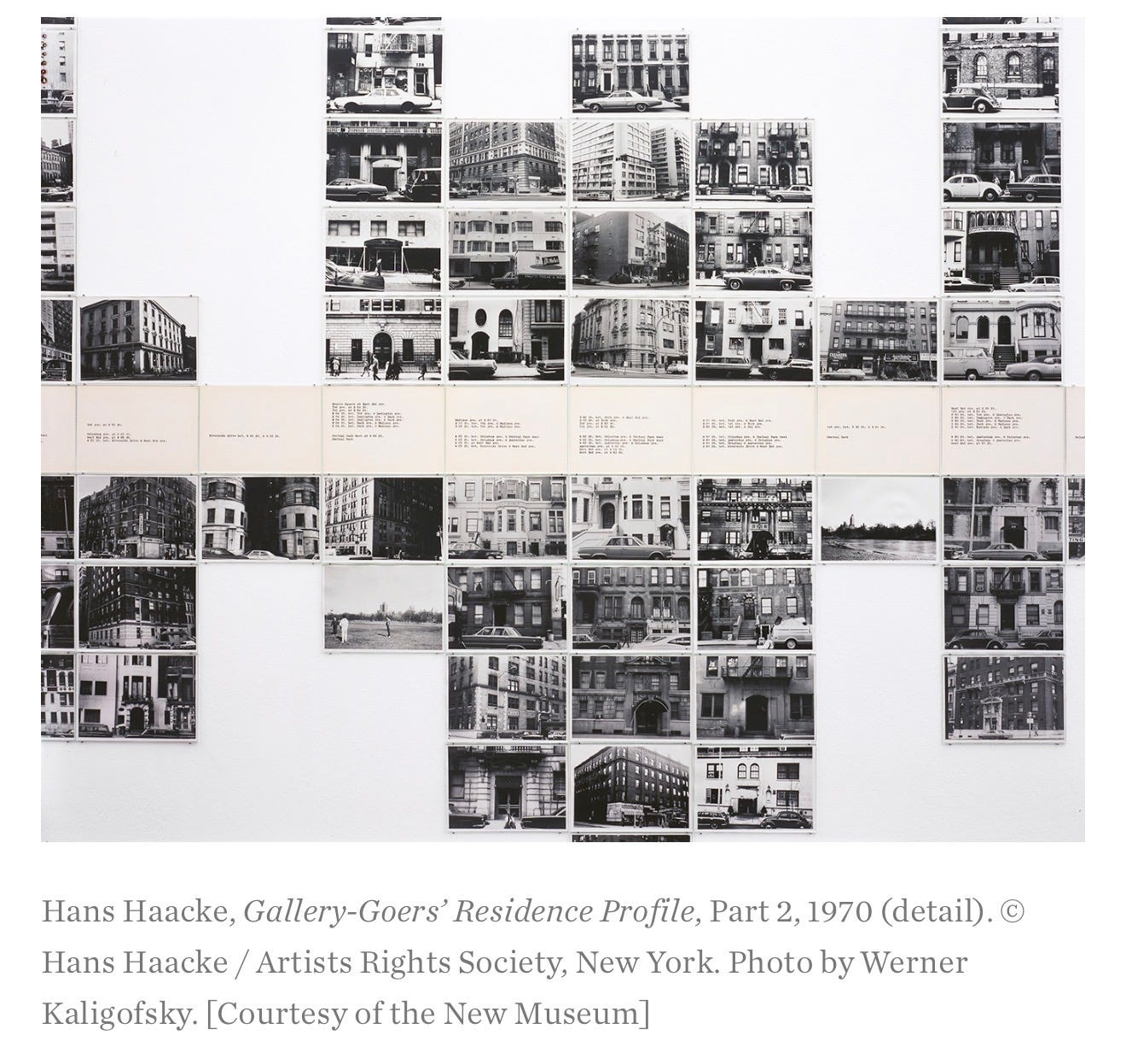
I’ve been circling this distinction for a while without naming it directly. In an earlier piece, I wrote about Hans Haacke’s 1971 show at the Guggenheim, the one that never opened. Haacke had built a body of work using publicly available real estate records to map the shell companies and slum properties tied to a member of the museum’s own board. The museum’s response wasn’t to critique the work. It was to cancel the retrospective six weeks before it opened. At the time, I framed this as proof that systems art had succeeded almost too well: it had stopped representing how power and capital move invisibly through institutions and had become an actual disruption of that movement. The cancellation wasn’t a failure of the work. It was the work completing itself.
(Places journal)
What I was really describing was systems thinking as a way of rendering invisible structures visible, ownership networks, information flows, incentive gradients that don’t show up on any map because maps aren’t built to show relationships, only positions. That’s a perceptual skill, not a location. You can stand inside the same museum, look at the same board of trustees, and see either a group of civic-minded donors or a web of financial interest with a museum attached to it. The room hasn’t changed. What’s changed is whether you’ve trained your eye to see the connective tissue instead of the individual nodes.
Maria Popova is what this looks like when the room disappears entirely. For nearly two decades, first as Brain Pickings and now as The Marginalian, she has read across science, poetry, philosophy, and art, writing essays that treat those fields as if the borders between them were bureaucratic rather than real. She isn’t a scientist, a philosopher, or a historian. She pairs Thich Nhat Hanh with Erich Fromm, Whitman with Buddhist teaching, Nietzsche with Seamus Heaney, not because the subjects overlap but because the underlying shapes do. I found her work before I had language for what she was doing. Enchanted, first, by the writing itself, the way she would pull something from quantum physics and set it next to a nineteenth-century poet and the combination would land with a kind of quiet logic, like two things that had always belonged together finally introduced. “We read to learn how to live,” she has written, “how to love and how to suffer, how to grieve and how to be glad. We read to clarify ourselves.” Where Johansson asks how institutions engineer proximity, Popova shows the eye can do it alone, no dinner party required, just the discipline of reading structurally instead of by category.

I made a related argument in a piece about moving concepts across domains, the practice of taking an idea that works in one field and deliberately testing it in another. I opened that piece with what I called an unforced error: a case where someone imported a framework from one domain into another without checking whether the underlying conditions still held, and the transplant failed in a way that was instructive precisely because of how it failed. The useful move isn’t noticing that two things resemble each other. It’s finding the point where the resemblance breaks, because that breaking point tells you more about both domains than the similarity does. Velcro is the cleaner version of the same idea. George de Mestral wasn’t a materials scientist. He came back from a walk with his dog covered in cockleburs, and instead of picking them off and moving on, he put one under a microscope and saw the hundreds of tiny hooks that had evolved to grab onto fur. He didn’t need advanced knowledge of textiles for the initial insight. He needed to look at a bur the way you’d look at a fastening mechanism rather than a weed. The translation from biology to industrial design happened at the exact point the hook-and-loop structure stopped being about the plant and started being a mechanical principle that had nothing to do with plants at all.
This is the piece I think Johansson’s geography leaves out. The Medici court was necessary but not sufficient. Plenty of wealthy families in that era funded artists and never produced a Renaissance, because funding proximity is not the same as cultivating the eye that can use it. You can put a chemist and a choreographer in the same room for a decade and get nothing, if neither has practiced the discipline of treating their own field’s assumptions as contingent rather than fixed, of asking what a shape, a mechanism, a data structure, an ownership pattern actually is, stripped of the vocabulary that domain uses to describe it. That stripping-down is systems thinking’s real function. Not diagramming complexity for its own sake, but developing the habit of seeing structure instead of surface, so a Galápagos finch or a clinging bur or a spice cabinet reveals its underlying mechanism rather than its local costume.
There’s a risk here, which I’ve written about before and won’t soften: systems thinking can become its own trap, mistaking the map’s elegance for the territory’s truth. Seeing connections everywhere is not automatically wisdom. Sometimes a bird is just a bird. But checking whether a pattern is structural or merely aesthetic is itself part of the practice, not a flaw in it.
The Medici family didn’t know they were building the Renaissance. They were patrons managing relationships, hedging their bets across a portfolio of talented people, most of whom they probably didn’t expect much from individually. The explosion of ideas that followed was an emergent property of proximity, not a plan. But proximity alone has been tried many times since, in accelerators and innovation labs and open-plan offices, without producing anything close to a Renaissance, because the room was never the active ingredient. The active ingredient was whether the people inside it had trained themselves to notice the hook under the microscope, the finch that didn’t fit the taxonomy, the real estate holdings hiding in plain sight in public records. The intersection is a way of looking you either bring with you or you don’t. The question worth asking is whether you’ve already trained your eye to see what’s colliding, right where you’re standing.
Nicole
please don't use AI, I really like your writing